

Bretagne
& the Grail

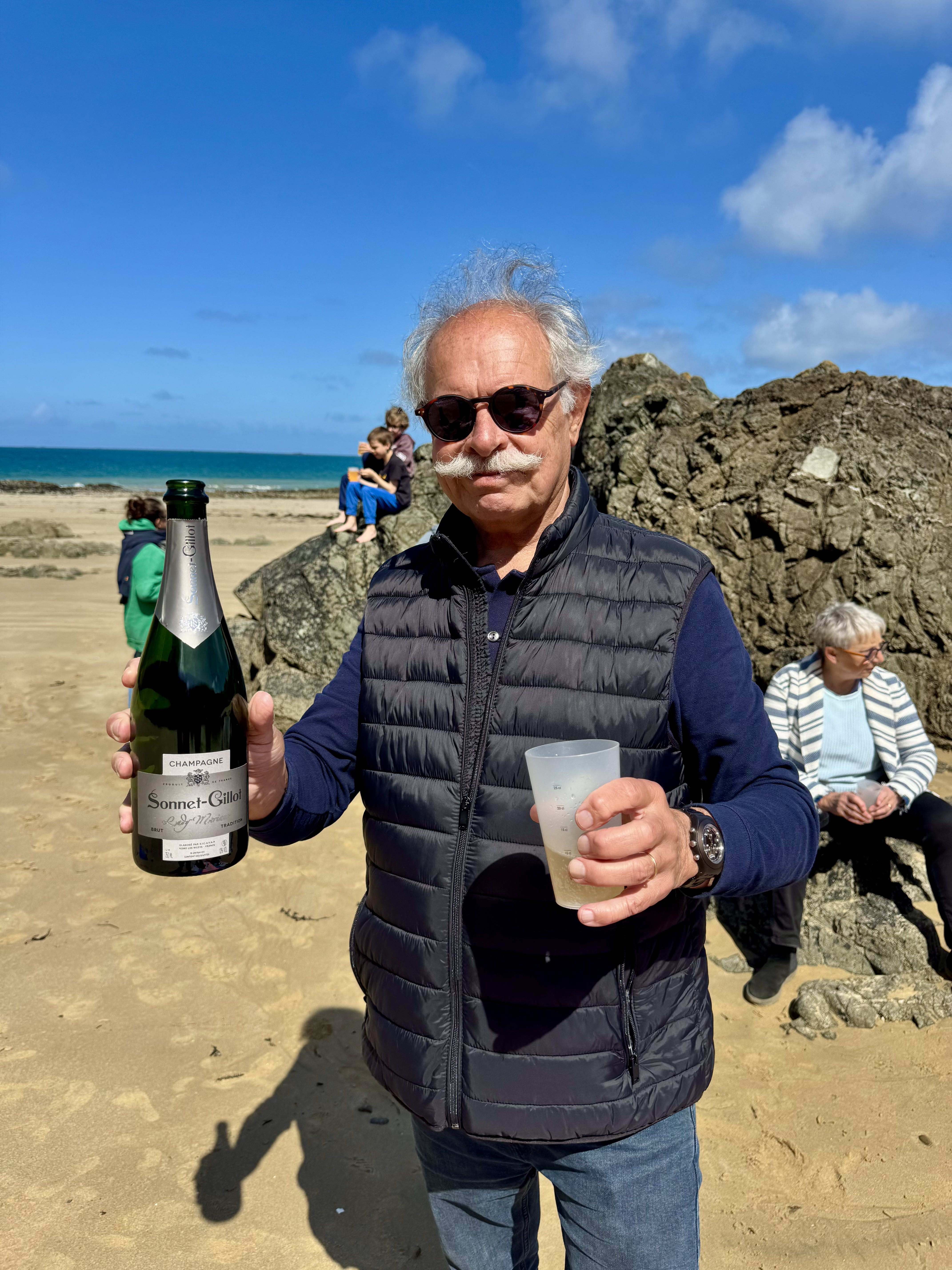
About a thousand years ago in what is now France, a guy named Chrétien de Troyes wrote but did not finish a book about a knight named Percival. The story included the first mention of the Holy Grail, and later spawned many of the legends of King Arthur. Some call Chrétien the inventor of the novel but whatever. In the 1960s, my mother was near Troyes on university break from Liverpool with her friend Maggie when they found themselves stranded before a shuttered youth hostel. A farmer took them in, and my mother and his daughter Evelyne struck up a friendship. In the 1990s my brother and I spent summers near Troyes with Evelyne’s sons Benoit and Bertrand, our adopted French brothers. A few weeks ago my son Percival met Evelyne, now 75 and a Senator in the French government, on a beach in Bretagne with her grandsons, not much older than my boys. We ate baguette with salted butter, and Evelyne’s husband François, my French father and quite possibly the most French man to ever have lived, popped a bottle of Champagne before telling me about his new bicycle and challenging me to a game of pétanque, which he won 9-1.
I’d been in France with my family trying to take a break. For reasons I cannot entirely explain, but which nonetheless don’t seem quite inexplicable, I’d found myself yearning for rest. Sleep, to be sure, but also a kind of emptying or quieting of the mind. Not meditation per se, which is something I’ve practiced on and off (mostly off) for a decade or so, but actual unconsciousness. I wanted to stop thinking for a spell. Short of rapping myself on the temple with a hammer or drugging myself with sleeping pills, it wasn’t altogether obvious how to achieve this, especially since my concurrent yearning was to spend time with my family — which, yes, entails thinking.
As it happens, I’d been catching snippets of conversations in the documentary film world about something similar. Namely, how much thinking we ask our viewers to do. It’s nothing new to peddlers of expository storytelling, but it’s come up yet again as streaming has come to dominate the way filmmakers distribute their work. (I resist or at least resent this trend!) Streaming isn’t the same as TV-watching, but there are similarities that can affect how you think about your film. You ask yourself questions about how people are going to watch: is it quiet and dark in the room? Are people catching every detail? Are they scrolling their phone while they watch? Are they watching it on their phone and not on the TV at all? Are they prepared to track complexity and hold multiple ideas in their minds at once?
I do not believe that people’s brains have changed so utterly that they cannot watch a movie, pay attention to details and, well, think. My friend Elliot likes to point out that people happily consume complex multi-character narratives on streaming platforms (think of Game of Thrones) where you more or less have to watch every scene to follow what the hell is going on. Can we not expect the same from them in a documentary?
Years ago, I found myself in the absurd situation of pitching a science series idea to a Netflix executive in a hotel room in Brisbane, Australia. The pitch was horrendous, but her main point of feedback was that it was too complicated. She told me to picture a viewer sitting on a couch with a glass of wine after a long day of work, phone in hand. Keep it simple and dramatic. The next day, as I scootered around town in the delirious sunshine, I puzzled over Netflix’s seeming pivot away from thinking, especially since my film then streaming on the platform, The Most Unknown, was described on its landing page as “cerebral.”
In Bretagne, we took our kids to the King Arthur forest one day — Broceliande. They have an exhibit at the visitor center where you immerse yourselves virtually in the mysteries of the forest, led by an audio-guide named Pierre. We were clocked as Englishmen by the staff and given minimalist and ineffective headsets, soon finding ourselves listening simultaneously to English and French Pierres at equal and equally incomprehensible volumes. My kids politely took off their headsets after a while and just watched the show, a blur of maps, fog, tree branches and swords. I kept up with the gist of the French, but also gave myself over to wonder after a while. I love forests, and recalled the comfort of flying home to Maine from Iowa during my early filmmaking days in those denuded corn lands, Maine our most forested state, the forests an almost inexhaustible font of wonder & mystery & shade & ticks. Beyond the comfort of the woods, I find the trees to be a good place to think — a cerebral setting, of sorts.
Broceliande gives you that most treasured quality of a natural setting — enchantment. The kids vetoed any forest hikes but we visited the sword in the stone and drove lovely roads arched with oak trees. Oaks are sacred to anyone who has any damn sense, and so it was with the druids whom Julius Caesar encountered during his conquests of Gaul. By some accounts the word druid means “oak-knower,” but who knows, it’s good enough for me that my family name is rooted in the French for oak, chêne. My parents’ woods here in Maine are full of them, mostly red. In France I bought six books on the druids, though there is broad consensus that everything we know for sure about them from antiquity could fit on a single page.
Reading these dense, speculative books using my high school French proved to be a conduit to unconsciousness of sorts. The beds in our tiny rental house were tiny, and many nights I retreated to the third floor bedroom with the shutters flung open to the North Atlantic, reading on a little twin bed with too many unread or unreadable books tumbled across it, like fallen menhirs, all of us, books and blankets and occasionally sleeping middle aged man waiting for the 5am rumble of the scallop boats so that we could reset for another day.
I cannot fathom what someone like Chrétien de Troyes thought of the audiences for his work, what notions he may have had nurtured about their attention spans in what we now call the middle ages, and whether as a middle-aged man himself he occasionally wondered what the hell was the point of writing book after book. He didn’t finish the story of Percival, which perhaps says something about his attention span, but then again this was a time of bards and minstrels and oral traditions too, before many of the old scrolls of antiquity had been rediscovered and passed around, so perhaps he finished it in some other fashion, in songs or sayings that didn’t get inked. My kids’ favorite film, Monty Python and the Quest for the Holy Grail, abruptly and absurdly ends before its own resolution, with Arthur and his gang getting rounded up by English bobbies. Who needs a tidy ending?
The streamers do, by any reckoning, given the formulae of Hollywood TV. A tidy ending means you don’t lay awake thinking & wondering; it’s a closed book, a groomed city park compared to the wild forests of real life. The story of my family’s friendship with Evelyne’s family is more of the sylvan ilk, leading heaven knows where, unscripted, an open book delight. Her younger son Bertrand, now middle-aged and bearded like me, met the love of his life Hiroko at EPCOT center in the early 2000s. She was working at the Japan pavilion, he at the French restaurant, and they fell in love in broken English. Later they moved to Sun Valley, Idaho, where he won a raffle for a new Mercedes which he promptly sold so he could buy a used maroon Cadillac, which he considered a “rapper’s car.” A few years back, I looked him up in Tokyo when we were in town filming for Shelf Life, our cheese film. We ate sushi and he rang up his parents in Troyes to tell them we were together. After hanging up, he looked at me somewhat bewildered, as if summing up the whole trajectory of our families’ comings and goings, or for that matter summing up the whole insanity of this life, which is decidedly unscripted, cerebral, with no grails or tidy endings but a font of things to puzzle over until our brains give out on us: “Crazy, no?”
🥂
merveilleux, Ian!