

Iowa
& landscapes of forgiveness

There used to be a place there called The Mill, in Iowa City. Eating there one night in 2003, I got into an argument with one of my colleagues about American capitalism. My view at the time was that the system was terrible, rigged to get the rich richer and the poor poorer. I was 23-years-old, and I felt I wasn’t making a particularly bold statement, but it caught the ire of my colleague who was about the age I am now. He pointed an angry finger at me, telling me my “ilk” were always complaining, and that America’s system was - it was an all caps delivery - THE BEST SYSTEM. I don’t recall responding with great maturity or clarity; despite having two degrees from Yale, I wasn’t much of a debater, and had only a childish grasp of socialist theory. Flustered and upset by the tone we’d taken up with each other, I left the dinner early and wandered around town in the December cold, kicking rocks.
I was fresh from graduate school, where I’d explored the disconnect between producers and consumers of food, a disconnect in no small way related to consolidation in the food industry — the big getting bigger, the rich getting richer. I suppose I imagined that our nascent corn film would engage a critique of American capitalism. These were the heady days of Michael Moore, and I figured we’d be muckrakers in the corn fields, harrowing up trouble and pointing a better way forward.
As I wandered the streets of Iowa City, fuming from the argument and concocting all my unspoken retorts in the inimitable esprit de l’escalier, I didn’t know whether we’d go forward with the film. We did. I like the film we made, about corn, even if it wasn’t what I’d initially envisioned. As a team we put aside our differing opinions about capitalism (and GMOs), electing instead to focus on the fundamental mechanics underpinning the whole system — farm subsidies as a reasonable idea gone awry. By nature I wasn’t much of a confrontational muckraker, nor were my colleagues. On the road, with our cameras, we were no Michael Moores. We ended up doing a lot of listening.
Many of my activist friends criticized the film, saying we didn’t go far enough in our critique of the system; fair enough. Maybe we could have done more, but then again those six words can surface in the aftermath of almost any effort. I do think the film was an honest account of our journey, our thinking, our listening, our time in Iowa — and in this sense, more than any other, it was a successful documentary.
But it took its toll on us. My older colleague and I don’t really speak anymore. He was a marvelous fellow who only rarely exploded with a temper, but his outbursts were admittedly terrifying —a vicious meanness I’d not encountered before. From his perspective I was probably a precocious, ungrateful leftist runt. I never found the words to explain to him how our working relationship made me feel, perhaps because I also felt indebted to him for helping make the film in the first place, or - more likely - simply because I was not courageous enough. I was afraid of him, a runt indeed. I pulled away after the film and started my own production company, an act which only further enraged him, and it became easier for me to wear the label of an ungrateful turncoat than do the work of confronting him about the psychological abuse I’d experienced.
In those early years, it took me a while to stop grinding my teeth at night from the anxiety of his presence. Around the same time, my girlfriend in Iowa and I went through a painful breakup. Looking back on it now, I think I was more than a little lost. My best friend at the time was going through his own swirl of breakups, but I found in him a powerful, sane, anchoring presence that I’m grateful for to this day. We invited our former Iowa intern - Taylor Gentry - to move to South Boston with us to make a movie about green building, and I started taking more pictures of the night sky. My jaw finally stopped hurting.
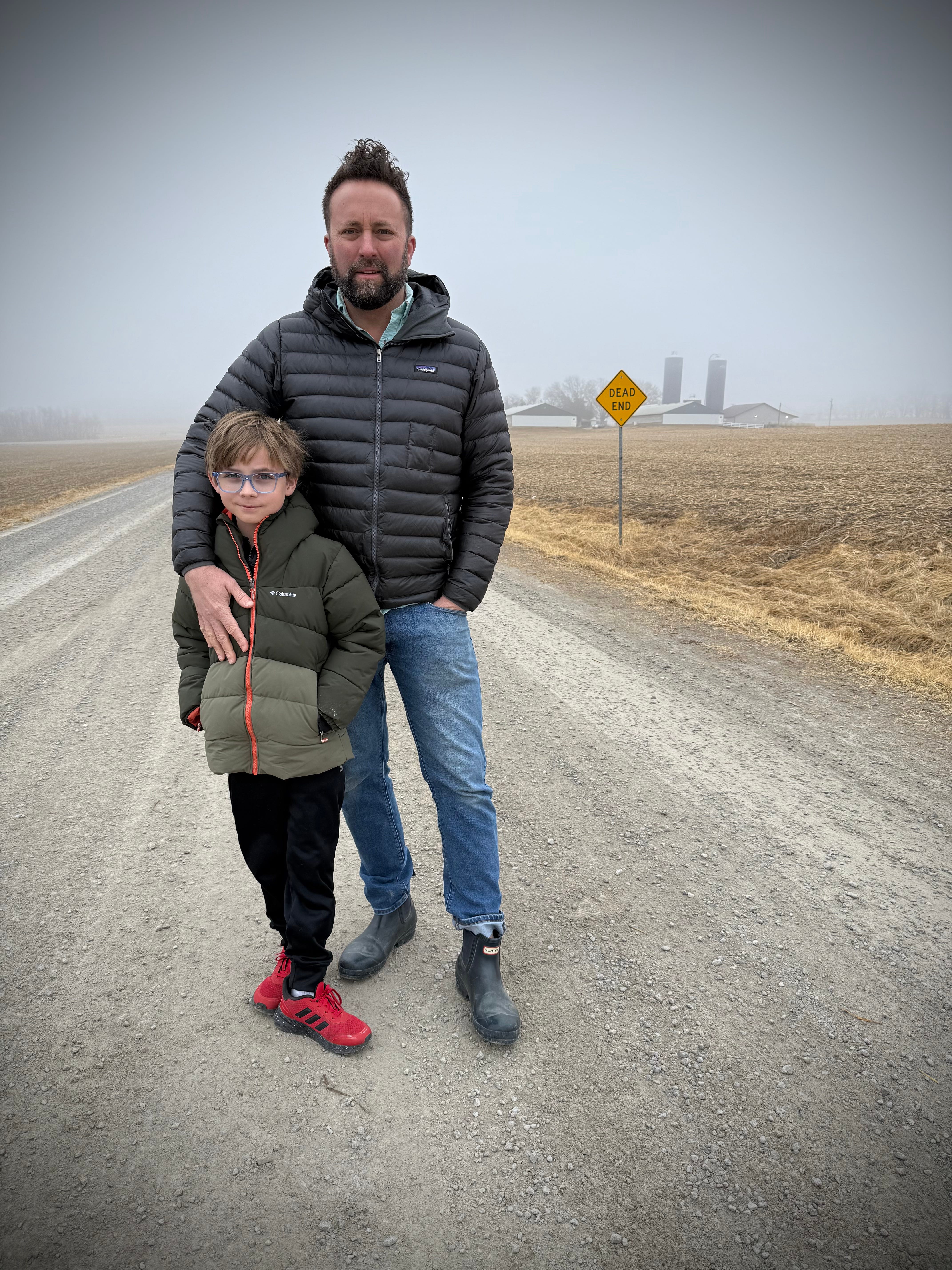
This was two decades ago. A few weeks ago I found my way back to Iowa for the first time since those corn days, for a week of filming on a new project. I brought my ten-year-old son with me on the trip, ostensibly to give him a taste of the filmmaking life, but also I think to give me an emotional center, a gravitational force of newness and joy that would keep me from tumbling back into the well of whatever I’d gone through in my twenties. I hadn’t been physically abused; people have endured far worse. But still I worried I’d be triggered in some form, start grinding my teeth or lose my way again.
I needn’t have worried. Maybe it’s that my own team of filmmakers now are the opposite of tempestuous; maybe the old scars have healed enough that I could immerse in the remembered delights of those Iowa adventures; maybe it’s that my son, both my sons, and my wife provide such a loving atmosphere at home that I’m simply stronger than before when I head out on the road; maybe people in Iowa are just darn nice. But the week was lovely.
The Mill is long gone, and I needed Google Maps to find my way around town, but the quiet brownness of midwestern March was somehow soothing. Fog clouded the landscape most mornings. My old member number, 20877, worked at the food coop. Eagles were everywhere. Fitting: our new film explores America on its 250th birthday, and we convened a series of conversations between Iowans young and old. With the exception of a few people who trotted out predictable talking points, most of the Iowans we encountered were thoughtful listeners, ready to hear each other and share perspectives. Many people in America are angry right now, but still people find a way to show up, pour a coffee, sit for a while. Why do people agree to be in our film?
It’s hard to listen when you’re angry, but it’s not impossible. I reckon forgiveness must be a part of it. When you’re hurt or angry, some small part of you must wish to forgive the person hurting you, because you sense therein a way forward, a twinkle of calm light. Activists like to chant “no justice no peace” but I think “no forgiveness no peace” is equally apt. Yes, there’s a lot of anger in America right now, but I wonder if there are also the seeds of forgiveness more or less everywhere; apart from the people who profit from division, powerlessness and strife (many of whom, let it be said, are dyed-in-the-wool capitalists), a lot of people want to climb out of today’s muck. Justice, forgiveness, peace.
After two decades out east, Taylor Gentry moved back to Iowa recently and we spent the week together filming. He was kind to my son, hard-working with our team, and made beautiful pictures to boot. He’s the sort of person who makes you feel like things are going to be all right. I saw the lousy old house where our corn team had spent two years puzzling through low-resolution footage and writing unsuccessful grant requests. For some reason, looking at the house, I remembered my best friend Curt preparing an avocado in the kitchen. He halved it and removed the pit. Poured olive oil in the wells. I’d never seen anyone eat an avocado like that, and come to think of it, I haven’t ever since.
Little memories are good for healing; we are not only our scars. I forgive the colleague with the temper. Who knows what he’d been through before those days, or what frustrations of his own he felt. I forgive the fool that I was bumbling through my twenties without a roadmap. (We didn’t have smart phones; how could I know my way around?) I forgive Earl Butz for rejiggering the farm subsidies, and the processed food industry for being so wrapped up in making money that they lost sight of the fact that they were making crap. I forgive my great-great-grandfathers for plowing up the beautiful prairie and planting corn.
I like to think now that Iowa got into my system somehow and shaped the filmmaker I became. I still probably talk too much when interviewing people, but I love the listening most of all, the learning and thinking. I love when someone changes my mind about something, and I can feel my stubbornness ebb away. Maybe these aren’t Iowa traits, but it helps to pin memories in time and space. Geographies of our emotional past help us understand where the heck we are now.
And where are we now? Can’t ignore the depth of the muck. Bombs falling in Iran, Beirut and Gaza. Unhoused people going hungry on cold streets. Generations of kids sucked into digital devices. Deportations, censorship & incarceration. Or what the Iowans said: topsoil disappearing. Well water polluted from hog farms. Innocent people mistreated. No justice, no peace; no forgiveness, no peace.
Listening isn’t always enough. And I don’t mean that we need to take to the streets, although we do. What I mean is that we probably aren’t finding a way to ask each other the right questions. About how we’re doing, about what we’ve been through. About where we want to go next. Here in the fuzzy throes of midlife, I’m quick to mutter “what is it all for?” But the questions and the listening bring me back to Earth. Iowa - despite its polluted well waters and depopulated rural towns and bursts of intolerance - brings a person back to Earth. Most of the prairie is gone but you can still glimpse it here and there, slowly building topsoil, nurturing life, arguably the ultimate metaphor for what happens when you stop cutting and let the living live — the arc of the Earth bending towards life.
At the end of our shoot in Iowa, I took Kepler to a basketball game at Carver Hawkeye arena. The film crew bought tickets too, and we all waved little yellow foam fingers and shouted our support of some rather tall young men who we’d never met, and would probably never meet. The crew ate hot dogs and drank Miller Lite. Kepler had popcorn. In the fourth quarter he took my hand and said, “let’s go home.” We left the game early and walked out into the Iowa dark, not saying much, but both I think enjoying the grasp of a new memory that we shared with each other, with the film crew he’d come to admire & adore, and with thousands & thousands of strangers in a basketball stadium in the middle of America in 2026.
Thank you, Ian, for sharing... I was born and raised in northern IA in a small rural town, about 6 miles from my paternal grandparents' farm. I attended the University of Iowa immediately after HS graduation, with its then-strong undergraduate liberal arts mission still intact in the General Education core, and my world opened up. My chosen major was Political Science & History/ Pre-law studies. We were in the throes of the Vietnam War protests, which were predominantly peaceful. Still, violent behavior on the part of local police attempting to control the mass of students sometimes occurred. I was an active "spectator", taking in as much as I could comprehend about the swirl of complicated issues being discussed: the draft, civil rights, women's rights, and the disproportionately negative effects had on middle and lower-SES Americans due to the continued involvement of the US in the War. War definitely makes the rich richer and depletes the backbone of any economy, the working class. I completed my undergraduate degree at the Univ. of Wisconsin-LaCrosse because I changed my major to Teaching and wanted to continue participating in Collegiate Women's Athletics ( Fencing, Field Hockey, and Softball), plus I was able to attain a full-ride scholarship, which covered in-state and out-of-state tuition waivers. I was excited to have the opportunity to be in another state, and my sister ( who had been attending community college) was able to attend the University of Iowa to complete her bachelor's degree. Upon completion of my BS degree, I pursued a master's degree while full-time teaching Middle School Health & Physical Education in Laramie, WY. Then went on to the University of Utah as a Teaching fellow and completed my Ph.D. I have now completed a 46-year career as a public school teacher/coach, a college professor, and a higher education administrator. I never returned to live in my home state of IA, except visiting family on vacations. But I, like you, have come to appreciate IA and the genuinely fine folks who have made their livelihood and homes on the prairies. I agree with your take on the lessons we can learn from connecting with people who value the earth. As a young woman, I left IA, but IA has never left me!!!
Beautiful Ian. I too have found it invigorating to bring my young child with me to places where I have a complicated history. They are ambassadors of wonder and joy and let you see and love the place in a new light.