

Strange courage
& America's 250th

Dear friends,
Gulls on the harbor ice were black this morning, looking like vultures on a battlefield amidst the sea smoke. -2°F driving the boys to school, my younger son slowed by the cold snap, so we played a bit of Ace of Base before drop-off, for pep. This time of year you can almost feel your money burning as you try to keep house, office and pickup truck warm. Nevermind that the new year brings a fresh look at finances and fitness; it’s slow going insulating a space in our cluttered timber-framed barn to house the rickety treadmill we bought during the pandemic, when the YMCA closed down. Running your hand along the walls, you can sense where the heat flows out into the wild.
We started a new film recently, a project exploring America on the eve of its 250th birthday. We’re shooting it fast, a snapshot captured during the first half of the year to be released as a feature documentary in the second half. At first it was bewildering: what goes in, and what does not? As we’ve swung into motion, we’ve found our boundaries and constraints, but this morning watching the sea smoke, sans camera, I wondered what it meant to miss this stark, contrasty harborscape in our time capsule; my brother and his family in southern Maine, protesting the fascist ICE thugs prowling for people of color; a bald eagle glimpsed the other day hunched over on a frozen lake, thick inches from its swimming prey. Black body, white head.
The film is a collaboration with Robert Reich, who quietly framed our journey a few weeks ago in Berkeley with a simple question: what do we as Americans owe each other? The idea of mutual responsibility is of course fresh on the mind during a time when our elected leader espouses selfish mores. But it’s also a nod, I think, to what was penned 250 years ago by founders steeped in Enlightenment philosophy. Shedding kings, people found themselves tasked with articulating a social contract: what rights do we give up as individuals, so that we together as a society can flourish? What commitments do we make to one another, recognizing that not everyone can make it on their own? Maybe our answers will help us understand the distance our hearts can travel, and what we can reasonably expect of our democratic project.
My colleague Elliot is married to a Hawaiian woman, and he suggested we film one of our chapters there; after all, many Hawaiians were born before the islands became a state, and many more have advocated for separation and sovereignty. A good place to ponder America, plus about 80° warmer than midcoast Maine. Oahu has become a trafficky place, nonetheless shot through with colorful beauty and the rich layers of intertwined cultures: it’s a complicated joy to visit there. I’ll save our gleanings for the film, but I want to mention here that many islanders, even before the swell of current madness, identified more as Hawaiians than Americans.
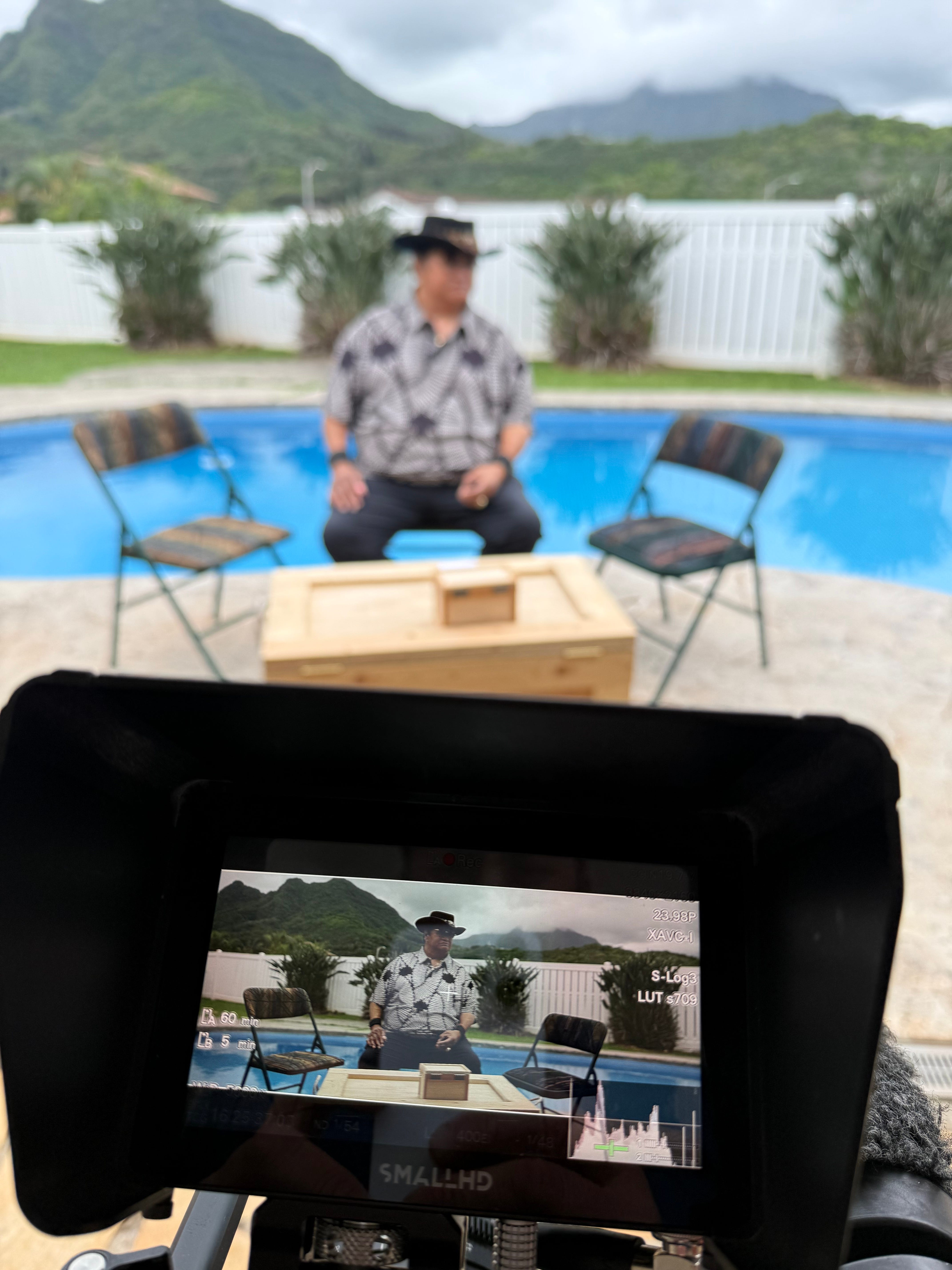
I get this, in my own way. I’ve long identified as a New Englander, not only because of my family roots in England but also because of a whole swirl of things, some more frivolous than others, that make this place home: landscape, family, memory, school, forests, sports teams, Dunkin’ Donuts. The first time I reckon I glimpsed democracy in any meaningful way was in Vermont during high school, when our teachers brought us to the town meeting. With only 400 residents in the town, the 40 or so assembled participants represented 10% of the population, and they set about with the business of keeping up the town. Taxes, school enrollment, fire trucks; decisions felt immediate and impactful. They needed a volunteer to mow the cemetery, and one of our teachers raised his hand. Before my eyes, people were giving up time and money to contribute to keeping the town livable for everyone.
Point is, we struggle with scale. Even putting aside the fact that America’s founding documents were put on paper before Napoleon sold Jefferson much of the continent, before Indians had been wrenched from their native lands, before the full scale of America’s forests & prairies & coal & gold had been tallied & pillaged — even putting all that aside, you have to wonder whether we’re conducting our democratic experiments at the right scale. (It is indeed an experiment, at least from the perspective of history; as one Hawaiian pastor put it to us, our country is but “a baby.”)
Capturing the contrast between the large scale at which our country attempts to operate and the smaller scales at which most of us live our lives is part, I suppose, of our challenge with this new film. I’m heartened to work with a team of 8 or 9 thoughtful people, even as we recognize that our own sliver of experiences will render a film that can only ever be a sliver of perspectives. Still, that’s the thing. That’s the American project. To remain distinct, individual, and free to express oneself, while still participating in, communicating with, and contributing to a larger whole. I have always liked these odd little lines by Wallace Stevens, which I read in high school, drawn by the astronomy reference, and have pondered since:
It’s a strange courage
you give me, ancient star:
Shine alone in the sunrise,
toward which you lend no part!
Forgive me, the lines were by William Carlos Williams. Though later quoted by Wallace Stevens. In case my English teachers are watching. :)
Beautiful as always. And a wonderful way to introduce the film and the efforts of our team. It's an honor to be part of it. Nevermind that the third shoot takes us to the frigid climes of Maine. But at least the spirit there tends towards wamrth.